
Our Journey Through Tuscany
“Along the hundreds of bends among the Tuscan hills, mobile phones either do not work or work intermittently. Tuscany simply does not allow you to divert your attention from it. From the golden hills planted mostly with wheat and vineyards in the Val d’Orcia, through the higher and wooded elevations to the north, all the way to the coastline, which we did not reach, but whose aroma, freshness and saltiness can be felt even in the wines from the interior of Tuscany.”

“And when you walk on millions of years old mussel shells nearly 100 kilometres inland, stand on one of the hundreds of hills and hear the history of each wine, you understand why a phone in Tuscany is completely unnecessary to us. You only need to listen, look, taste and absorb every drop of Tuscany. And then go home, write and relive it.” An excerpt from our article about the wines of Tuscany, written by Mimi.
A Morning at Tenuta Sant’Agnese
Every single day in Tuscany could become a separate article or story, and after every trip there you could write a book. In Tuscany, everything is like a scene from a novel. After all, all novels lead to Tuscany! We had a dream to find ourselves there during the grape harvest, to drink wine, seek culinary adventures and immerse ourselves in the romance of the medieval towns and villages.

We arrived late in the evening in Montepulciano, passed through the town almost without looking around as the GPS guided us along the dark roads, and stopped in front of a house on the outskirts. We were greeted by Giuditta Fanetti, who got into her tiny car and told us to follow her. We drove for another two or three minutes along the dark roads of Tuscany and parked next to yet another lonely house among the hills. In the dark, we walked past some hedges. It had rained and was damp. We reached a dark house that was at least a century old and went inside.


A cosy Tuscan house, exactly as we had imagined it, slightly cool due to the autumn weather outside, with blue walls in the bedroom, a large bathroom and a kitchen with some equipment we did not intend to use. We liked it immediately. However, we did not stay there that evening at all, but freshened up, put on our formal clothes and set off for Montepulciano again.
Montepulciano
Montepulciano is a small picturesque town situated on a hill in the Val di Chiana, adjacent to the Val d’Orcia, which we will mention later. It is one of the exceptionally beautiful medieval towns of Tuscany. There are so many of them that you might even miss most, but here the spirit of the medieval houses and steep streets have a unique charm that we highly recommend you see and spend a few hours exploring. We dedicated a whole day and would have gladly stayed longer.

Our Favourite Restaurant in Tuscany, Le Logge del Vignola
We parked the car somewhere near the central part of Montepulciano. There were many small car parks that were already free of charge, but during the day you have to pay. The evening was slightly chilly, and the voices of people could mainly be heard from the town’s restaurants and wine bars. We have told you about our passion for seeking out the best restaurants when we travel, and so today life brought us to Massimo Stella and his daughter Virginia Stella at Le Logge del Vignola.


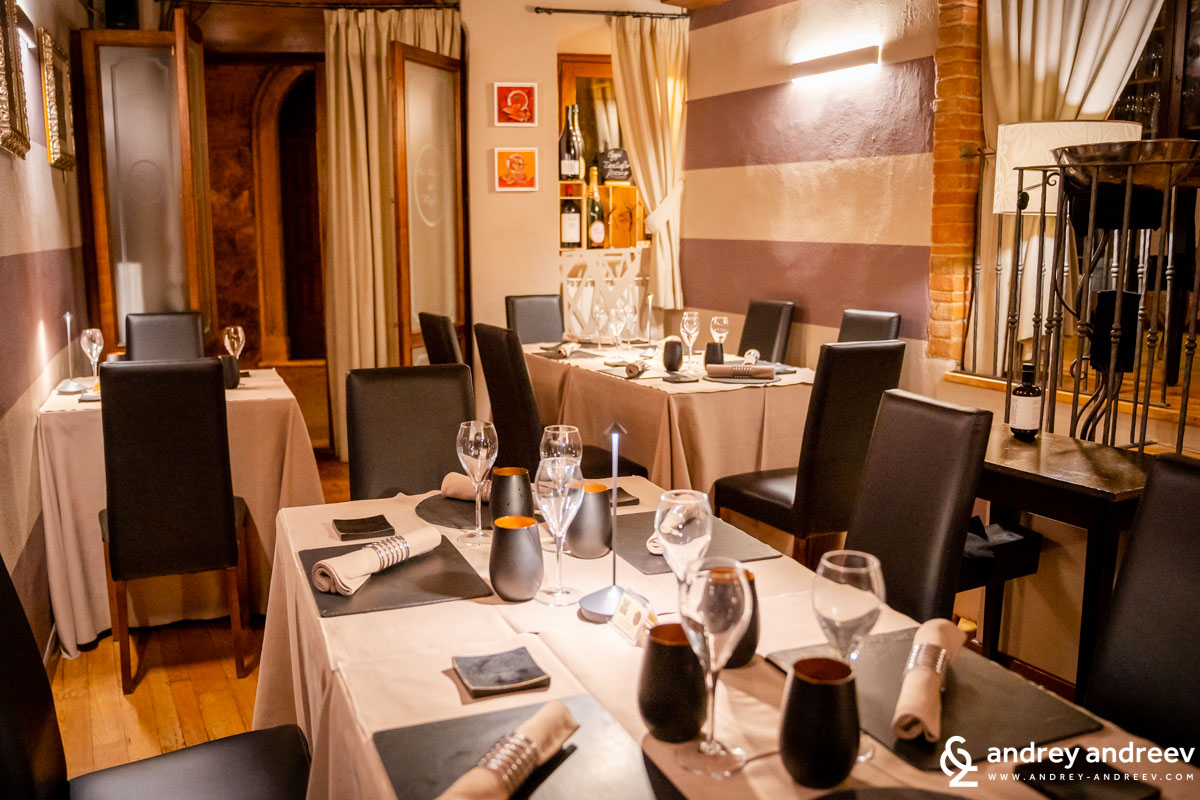

If for you every place is defined by the cathedral and the main square, and sometimes by the remains of a castle somewhere among the houses, for us the soul of every town is the place where we dined. When there is no spirit, even the most beautiful city pales in comparison, but Massimo and Virginia made us leave a piece of our hearts in Montepulciano. This cosy place with flawless service, which we found among thousands of restaurant recommendations in the region that we filtered through, impressed us with its signature cuisine and perfect hospitality. The service is entirely provided by Massimo and Virginia. We stayed until after midnight, the last customers, and began discussing the Stella family’s winter plans.


We leave, say our goodbyes, exchange contacts, and over the following days we message each other on Instagram. Meanwhile, Montepulciano after midnight is deserted. We meet no one during the cold autumn night in the streets, but perhaps during the lovely summer nights it is different.


Caffè Poliziano
Any local from Montepulciano will recommend that you drink coffee at Caffè Poliziano. After all, you are tourists who have come to see the most significant places in the town. Caffè Poliziano is a café and restaurant dating back to 1868, which was restored to its authentic Art Nouveau appearance in 1992. Legends surround Caffè Poliziano and its guests, the most beloved of all being about Federico Fellini and how much he adored the place.


We sit down for a coffee early in the morning to try their cakes and tarts. The atmosphere is extremely elegant, sunlight floods in through the windows, and the terrace reveals a view of the valley. A waiter who seemed to have got out of bed on the wrong side serves us with slight disdain, and after our coffee, we pay at the till. The place is beautiful and a must-visit, but try not to burden it with high expectations so that you can truly enjoy it.


The Wine of Montepulciano
Our plans for every place we visit involve tasting something, seeing something, and learning something. In Montepulciano, the narrative must now detour towards wine. Specifically, Vino Nobile (Vino Nobile di Montepulciano) and Rosso di Montepulciano. These are the two wines you absolutely must try in Montepulciano. Moreover, as you stroll through the town, you will spot dozens of wine shops and wine bars. You can literally enjoy a glass of Vino Nobile anywhere.


We dropped by the Fanetti family winery, which is located in the town. The Fanetti winery is actually the birthplace of Vino Nobile, but I recommend you try other wineries too and find your own favourite. Vino Nobile is a wine with character, and you have to be a match for it. If you visit Fanetti, ask them to take you in amongst the barrels, the place itself is exceptionally authentic.

Accommodation in Montepulciano: Montepulciano is a small town, and you cannot enter the old part by car. You can park in the paid car parks. A very nice option is to stay in one of the surrounding farms or guesthouses, just as we did. Estates or wineries scattered across the valley, boasting stunning views and often very romantic atmospheres, are in abundance. We stayed in a house owned by the Fanetti family, but staying in the old part of Montepulciano would also be a superb experience.
Montalcino
It is the end of September, dawn breaks a little later, and we managed to wake up at sunrise just as the sun was rising over the Val di Chiana. It had rained slightly during the night, and the tiny droplets on the leaves of the small Sangiovese vines around the house reflected the sunlight. Somewhere in the distance, it looked like more rain, and soon enough it began to drizzle on us, filling the pool with small ripples formed by the drops. The view over the undulating shapes of the Tuscan landscape was enchanting. And there we were, sitting in the Fanetti family’s house (Tenuta Santa Agnese), rejoicing in yet another day in Tuscany.

Montepulciano sits right on the border between the Val di Chiana and the Val d’Orcia, which is where we are heading today. Here we will see Montalcino, Pienza, Sant’Angelo in Colle, and the Abbey of Sant’Antimo.
In Montalcino, we will recommend the Boccon Divino restaurant: Restaurant Boccon Divino, where old Tuscan dishes live a new life
Val d’Orcia
The Val d’Orcia valley is part of the UNESCO World Heritage list because of its pastoral landscapes, which have inspired more than one artist. We set off along the roads of the Val d’Orcia and simply cannot get enough of its beauty. During these few days, rushing between Montalcino, Pienza, and Montepulciano, we become convinced of the incredible splendour of the place. We stop by various hills, watching sunsets and sunrises. The entire valley is endlessly beautiful. And so, mesmerised by the beauty of the Val d’Orcia, we never stop discovering places in Tuscany that are new to us.

Early in the morning, we have an appointment at a winery on the outskirts of Montalcino, where we are to taste some of the most emblematic wines for Tuscany, Brunello di Montalcino and Rosso di Montalcino. We pass through Montalcino and park the car in front of the Collemattoni winery near the village of Sant’Angelo in Colle, sitting down to chat with the owner over a lovely glass of Brunello with a view of the vineyards. It is not even lunchtime yet.

She tells us the history of her family and, one thing leading to another, recommends that we visit the village of Sant’Angelo in Colle for lunch and eat at one of the two restaurants in the centre. But before that, she suggests we head down to the Abbey of Sant’Antimo, which is reached via a dirt road through the vineyards.
Collemattoni Winery: the southern face of Brunello di Montalcino
The Abbey of Sant’Antimo
The abbey is actually about a 15-minute drive from Montalcino along a tarmac road, but we have deviated westwards for the winery and have to take the dirt track that leads us directly above the old church. The Abbey of Sant’Antimo is one of the most visited and photographed places in the area. It is believed to have been founded sometime during the era of Charlemagne (8th-9th century), but the first sources mentioning the Benedictine abbey date from the time of Henry III in the 11th century.


Over the centuries, the place has seen periods of both development and decline, including times when the building served as a stable. The foundation of the abbey is tied to legends surrounding Charlemagne and the relics of Saint Antimus of Arezzo, which were gifted to Charlemagne by Pope Adrian I. It is believed that the relics were moved here in 781. The current church, however, was built at the beginning of the 12th century. During this period, the monastery and the towns throughout Tuscany were flourishing. The pilgrim route Via Francigena, which started in Canterbury and ended in Rome, also passed by the abbey. The towns of Lucca, Siena, and San Gimignano, which we write about further down, are also on the Via Francigena.

Sant’Angelo in Colle
If you think we have already headed towards Montalcino, we haven’t. We got into the car and headed back along the dirt track among the vineyards, surrounded by beautiful views of small hills dotted with churches, villages, and towns, returning to Sant’Angelo in Colle.


Around 200 people live in Sant’Angelo in Colle, yet the place is exceptionally pleasant and well-preserved. It is quiet, peaceful, and entirely off the beaten tourist track. We left the car in a car park outside the fortress walls and made our way to the restaurant in the centre of the village, where we had booked a table literally an hour beforehand.


There are two restaurants in the village, both very good. However, exactly on that day, only Trattoria Il Pozzo was open. We sat down and enjoyed magnificent local dishes and regional wines. For us personally, the restaurants of the village, and the village itself, proved to be a superb discovery, calm and beautiful.
Montalcino
Montalcino is yet another magnificent Tuscan town with a beautiful historic centre, fine restaurants, wine bars and everything else you might need in Tuscany. However, around Montalcino, one of the most emblematic wines in Tuscany is produced, Brunello di Montalcino, making this the perfect place to visit at least one winery. We had received very pleasant recommendations for two of them. One, Eredi Fuligni, is one of the most respected wineries in the Montalcino region, boasting a long history. The other is a newer gem offering fantastic wines, Collemattoni.


We took a walk around Montalcino and explored. We slipped into the fortress of Montalcino and peeked at the children playing football on the pitch at the foot of the fortress. The day was drawing to a close, and we were already quite tired from all the sightseeing, eagerly waiting to head to the restaurant with a beautiful view that we had booked in advance, Boccon Divino. There, we were met by two very vibrant ladies, the owners of the place, who simply won us over entirely with incredible food and a very fine bottle of Brunello di Montalcino.

Accommodation in Montalcino: Should you stay in Montalcino? Why not, although the challenges are similar to other Tuscan towns, namely paid parking and a central area inaccessible to cars. On the plus side, Montalcino is not a large town, and strolling there is highly pleasant. A brilliant option is to stay in one of the farms or guesthouses. Estates or wineries, scattered across the valley with breathtaking views and often very romantic, are plentiful.
Pienza
In the small village of Corsignano, Enea Silvio Piccolomini was born in 1405, later becoming Pope Pius II. Pius II decided to transform his village into the ideal Renaissance city. Since 1996, Pienza has been on the UNESCO World Heritage list.
We found ourselves in Pienza in the evening, when the autumn twilight had already set in. We parked at the foot of the walls in a paid car park. It turned out we had parked right next to the gate adjacent to the Duomo in Pienza, the Porta al Santo, from which we climbed up to Piazza Pio II. The cathedral was built between 1459 and 1462.


From here we headed left towards the western gate, Porta al Murello or Porta al Prato, and then returned towards Porta al Ciglio. Pienza is not a large town, but it is an exceptionally beautiful one. You fall in love with this place, and there were hardly any tourists. We wandered the streets and browsed the shops, which were already closing. They are geared towards tourists, very nicely arranged, and tempt you to buy wine from the region or the town’s specific cheese, Pecorino di Pienza, which you simply must try.

Dinner in Pienza
We slipped into a restaurant, Trattoria La Buca delle Fate, duly recommended to us by our friends from Montepulciano. It is an ordinary place, full of Italians and tourists, but it is fantastic. Here we enjoyed a delicious beef steak, you should try the beef steaks everywhere in Tuscany, as well as the local pici pasta. We loved them. We ordered a glass of Brunello di Montalcino from a popular winery; it is not expensive, we will talk about the expensive ones later. We liked the restaurant, the waitress, and the people.


We leave the trattoria and resume our stroll. It is ten o’clock at night, and there are no people left in the town. We love Pienza, and as I write these lines, I wish I were there again, eating my ‘bistecca’, drinking my Brunello di Montalcino, and telling you about the Pecorino di Pienza.

Accommodation in Pienza: Pienza is a small town, and you cannot enter the old part by car. You can park in one of the paid car parks. A very nice option is to stay in one of the surrounding farms or guesthouses. Estates or wineries, scattered across the valley with breathtaking views and often very romantic, are plentiful. We stayed in a house owned by the Fanetti family near the neighbouring town of Montepulciano, and we really enjoyed being isolated. Pienza itself would also appeal to us as a place to stay.
Siena
Probably everyone falls in love with Siena!
We drove gently between Montepulciano and Siena, as I lacked a bit of confidence in the rental car we had picked up at the airport in Bologna. Actually, the most convenient options for reaching Tuscany from Bulgaria at the moment are to land at the airports in Bologna or Rome. There used to be flights to Pisa, but currently, there are none. However, these things are dynamic, and there might be some next year.

Our car is red, and although it is ‘non-Italian’, it is comfortable, and the fact that I am not driving fast is actually quite pleasant. The views in Tuscany are definitely worth it. It is raining. In the province of Siena lies one of the most famous Tuscan wine regions, Chianti. Well, to be precise, Chianti is not in Siena, but Siena is in Chianti. Here you can find magnificent Chianti and Chianti Classico wines. And so, we first ‘got lost’ among the mountains around Siena looking for a winery. We ended up at Riecine. It continued to drizzle. The views from the wineries are wonderful, especially when they are situated in a mountainous region. Thus, our morning in the province of Siena began with a beautiful view, a glass of wine, and a pleasant conversation with locals.

Chianti
Chianti is the largest wine region in Tuscany and probably the most famous in the world. Wines from the Chianti region have been documented in historical sources since the 14th century, which mention the wines from the ‘Chianti Mountains’ near Florence. In 1716, Cosimo III de’ Medici, Grand Duke of Tuscany, issued an edict officially designating four villages that had the right to call their wine ‘Chianti’: Castellina, Gaiole, Radda, and Greve. Today, the Chianti region is significantly expanded and divided into several sub-regions. At its heart lies the Chianti Classico zone, where these very historical villages and their surroundings are located.


Riecine won us over, but the day had just begun, and we set off for Siena. We found a convenient paid car park, abandoned the red car, and set off to explore the city. The car park turned out to be somewhere below the Chiesa di Sant’Agostino and very close to the most popular attraction in Siena, the Piazza del Campo (1293). We descended through the Porta Sant’ Agata to the square, which is shaped like an inverted shell and where hundreds of tourists had gathered. The rain had paused for a moment, granting us the opportunity to see this part of Siena.
Piazza del Campo

In the lower part of the square is the town hall, Palazzo Pubblico, and next to it stands the second highest tower in modern-day Italy, the Torre del Mangia (102m). The tower was built between 1338 and 1348, deliberately matching the exact height of the cathedral’s tower in Siena to demonstrate that secular and religious powers are equal. Although the cathedral’s tower is 10m lower, the cathedral itself sits 10m higher than the town hall. The name of the tower, Torre del Mangia, derives from the nickname of its first bell-ringer: Mangiaguadagni, a certain Giovanni di Balduccio. He was notorious for his vices, especially his culinary ones, and for ‘eating up his earnings’ (which is roughly how it translates, my Italian is not the strongest).
And since the people of Siena are well-known for their love of giving nicknames, the name of the tower has remained the same to this day.


On Piazza del Campo is also the beautiful fountain known as the Fonte Gaia, or ‘Fountain of Joy’, designed in 1419 by Jacopo della Quercia. The current fountain is a copy of the 15th-century original.
Through Rainy Siena
We stood on the square, right next to the fountain, and it began to rain again. And so we set off to stroll through a wet and rainy Siena, which in no way dampened its beauty; we simply hid under an archway from time to time. We may have missed some key spots, but two of the places we did pop into were:
- Pasticceria Nannini Conca D’Oro, an extremely popular café and patisserie, where you can buy panforte. Panforte is a highly popular and exceptionally local dense dessert bar filled with lots of dried fruit and nuts, as well as plenty of spices such as cinnamon, ginger, and even aniseed in some versions. It is a great idea if you want to take some treats back home. Personally, the traditional panforte appealed to me the most.

- La Taverna di San Giuseppe is a very, very good restaurant near the Porta Sant’ Agata, where you can taste Tuscan cuisine paired with Tuscan wines. The restaurant is outstanding and well-known among people seeking good food, so you must book a table in advance.

I am certain that the time we dedicated to Siena was not enough. The rain reduced it significantly, and I definitely want to return to this city, which we liked immensely. But we still had many more wonderful places ahead of us to be impressed by.


Staying in Siena: Why not?! Siena is a university city, and here the students are almost more numerous than the residents. The city is exceptionally pleasant and offers many possibilities.
San Gimignano
Before Reaching San Gimignano, Fattoria Poggio Alloro
It is the end of September, and ‘Sunny Tuscany’ has surprised us with a full day of rain. But there we are, sitting in one of the good wineries in the region, Fattoria Poggio Alloro, which also has a restaurant that was recently in the Michelin guide, though it isn’t currently. The service has not changed; it remains just as excellent. We are drinking local wines, already on our tenth bottle, and simply taking in the view.


We are sitting outside, under a shelter with tables. Next to us are some English people who initially do not like the wine, but we offer them some guidance, strike up a friendship, and continue to admire the view. And the view is staggering. The towers of San Gimignano alternately hide and emerge through a cluster of rain clouds. Sometimes the whole town disappears, making the hill of San Gimignano look as if it has been sliced off.

While sitting here and discussing wine, we will tell you that around San Gimignano you must drink white wine from Vernaccia DOCG, the red Chianti Riserva DOCG, and Vin Santo del Chianti, a dessert wine. You will find more about the wines in our article on the wines of Tuscany. As for the food, in the restaurant you can try Bistecca Fiorentina from Chianina cattle, which they breed right there in the adjacent building. This is exactly what we did, but by early afternoon we decided to brave the rain and explore San Gimignano.

The Towers and the Peculiar Aristocracy of San Gimignano
We parked in one of the several car parks around the old town, climbed some stairs to the fortress wall, and slipped into the streets of the town. Yet, let me bring you back to the view of San Gimignano. The most exceptional and beautiful element of this view are the towers rising above the town, a symbol of the wealthy families. You can sense this tower-building trend in Bologna and Lucca too, but here it possesses its own unique charm. Situated on a hill rising above the Elsa river valley, strategically chosen by the Etruscans and subsequently a stop for pilgrims heading to Rome, San Gimignano reached its golden age during the 13th and 14th centuries.


The wealthy families of the town decided to compete over who was more influential by building tower-houses. There used to be 72 of them, but only 14 have survived to this day. Nowadays, you can stay in one of the towers, where the prices are quite striking, but if I had the opportunity, I would certainly take it. Do not worry, in the town and its surroundings, there are superb places to stay.


When you step behind the fortress walls, it is impossible not to fall in love with the place. Despite the cold rain, there were quite a few people in the streets. Some ladies were singing hymns in a niche in front of the Collegiate Church of Santa Maria Assunta, and the acoustics were magnificent. This is why we travel; every place seen in person is far better, or at least beautifully different, than the mood we can perceive through photographs.


The Best Ice Cream in the World… Or At Least It Used to Be
From the San Matteo gate along Via San Matteo, and from the other side of the town via the San Giovanni gate along Via San Giovanni, you reach Piazza della Cisterna and Piazza del Duomo. It was here that we stopped to try the best ice cream in the world (awarded in 2006/2007 and 2008/2009), at Gelateria Dondoli. Imagine this: it is cold, it is raining, yet there is a queue winding out of Gelateria Dondoli. The ice creams are mind-blowing, and generally, you will be amazed at the combinations available. I highly recommend them. Quite nearby, there is another gelateria with a sign reading, ‘Il Gelato Più Buono del Mondo’ which means ‘The best ice cream in the world’. I am certain the ice creams there are superb too. And further down Via San Giovanni, you will find ‘The first homemade ice cream since 1924’. You get the idea.


Sights in San Gimignano
The entire town centre is on the UNESCO World Heritage list. You can visit San Gimignano 1300, which houses a ceramic scale model of the town and its appearance in the year 1300. The cathedral is a magnificent piece of art, particularly its frescoes. With its restaurants and wine bars, San Gimignano is a highly touristic destination that will completely captivate you.

Staying in San Gimignano: The place is grand, and I would gladly stay here. Accommodation is relatively expensive for the region, and you have to park in a paid car park near the old town, as cars are not allowed within the fortress walls. Moreover, the town boasts lovely restaurants and wine bars, so you will not be bored in the evenings. However, staying in one of the many guesthouses and farms in the surrounding area should not be overlooked. We stayed in a village about an hour’s drive away.
Pisa
Pisa was on our list of destinations primarily because of the Leaning Tower of Pisa and the Square of Miracles, where the tower is located. We travelled from the heart of Tuscany to Pisa and parked in the car park right next to the square, Parcheggio di Piazza dei Miracoli. We walked past a cluster of market stalls, McDonald’s, and whatever else you can think of that you shouldn’t eat in Italy. Through the Porta Nuova, we found ourselves on the Square of Miracles, or the Piazza del Duomo.
The Square of Miracles

In the centre of the square, the cathedral, the baptistery, and the leaning tower will take your breath away. They dominate as an attraction, and all eyes are directed towards them.

The construction of the Leaning Tower of Pisa began in 1173 as a project for a very beautiful ‘campanile’, a free-standing bell tower. However, due to the weak foundation soil, the tower began to lean almost immediately after construction started. A period of several decades followed during which the tower remained unfinished, but it was finally completed in 1372. Beautiful and continuing to lean, the tower is a staggering sight even today. You can climb to its top, or you can simply mingle with the crowds of photographing tourists pretending to prop it up, along with other cliché poses.


The Duomo is also one of the most beautiful cathedrals we have ever seen. It was built between 1063 and 1092. The cathedral was constructed outside the then fortress walls of Pisa to demonstrate that the city did not fear attacks. The Cathedral of Pisa is dedicated to Santa Maria Assunta (Our Lady of the Assumption). Opposite it is the magnificent building of the baptistery, completed in 1363.


Around these three buildings, there are exceptional museums and locations. On the northern side is the Camposanto Monumentale, the cemetery of the noblemen of Pisa. Every building around is significant for something, and I recommend you dedicate some time to them if you are in Pisa. However, you can also be like us, slightly weary of the crowds of people, and head towards the river Arno for an ice cream instead.
Through the Streets of Pisa


We ended up on Piazza Garibaldi, and in front of us was the Ponte di Mezzo bridge over the river Arno. The river surprised us slightly with its complete lack of trees along its banks.


Pisa is known not only for its tower and its cathedral. Galileo Galilei was born here; he studied at the University of Pisa and taught there during a certain part of his life. Leonardo Fibonacci, the mathematician, is also from here. If you delve into the history of the city, you will come across many famous and important figures. You will also encounter Ugolino della Gherardesca, a character from Dante Alighieri’s ‘Divine Comedy’ (Alighieri being from Florence).

Staying in Pisa and Lucca: Pisa and Lucca are large cities and you can easily find a place to stay, with many options available. We had chosen to be in the centre of Tuscany, in a house in the village of Chianni, enjoying the peace, quiet, and wine, and we drove about an hour to Pisa and Lucca. On the other hand, Pisa has many restaurants and bars to visit in the evening. I am attaching a small excerpt from booking.com so you can get an idea of the prices.
Lucca
It turned out to be difficult to park during the day in Lucca. There are several car parks near the old town, but they were all full, and we had to wait for a space to free up for our rental car. Eventually, we managed to park at Parcheggio Cittadella.

The first thing you must see, and naturally notice, in the city are the preserved fortress walls. You can walk around the entire old town along them, and they are a favourite spot for a stroll or a cycle for both tourists and locals. We started from there.

Lucca is very close to Pisa and Florence. Its architecture is remarkable, and walking through the city is incredibly pleasant. We did not have much time, as we had booked a restaurant outside the city, which turned out to be a remarkable place in its own right. Scattered throughout the city are many bell towers and towers erected during the Middle Ages by wealthy families. One of the most impressive, built in the 14th century, is the Torre Guinigi. Which I don’t think I photographed… Anyway, at its very top, there are seven oak trees planted. You can climb the tower and take a sweeping look at the city from above.

The Amphitheatre Square
As you wander through the streets of Lucca, you can, and indeed must, find yourself on a square with an elliptical shape. ‘La piazza dell’Anfiteatro è una piazza della città di Lucca’ – The Amphitheatre Square was built on the site of the ancient Roman amphitheatre constructed here in the second century. Today, the houses surrounding the square follow the walls of the Roman structure, and you can enter it through four passageways. It is brimming with little restaurants and a great atmosphere.


On the site of the Roman forum, the Chiesa di San Michele in Foro was built, dedicated to Saint Michael the Archangel. San Michele is a Roman Catholic basilica adorned with multi-coloured marbles, influenced by the Lombard style.


Lucca is not just a few landmarks; it is full of tourists, Italians, Tuscans, and life, making it one of the most delightful Tuscan cities. You can drink fine wine in the city’s bars, sit down in local restaurants, and simply savour the magnificent emotion of Tuscany. We left the walls of the old town with an almost heavy heart after a few hours of walking, and set off towards our next destination.

I wonder what I am missing about Lucca; what would you recommend seeing or doing in this extraordinary city?
While we were in Pisa and Lucca, we did not look for a place to sit down for dinner because we had booked dinner at The Lucky Star of PS Ristorante is Green, Restaurants in Tuscany, Italy. It is not exactly close by, but it is an incredible restaurant.
Staying in Lucca: Lucca is a large city, and you have many accommodation options. In the old part, you must be without a car or park in one of the paid car parks, which makes it quite a bit more expensive. You can stay outside the fortress walls and get around by public transport. You can also reach the city by train. We chose to sleep in the heart of Tuscany, and Lucca was merely a destination we drove to, about an hour and a half from our Tuscan house.
Tips for Tuscany
- Although the distances between the towns are small, bear in mind that travelling between them takes time because the roads are mountainous, albeit in good condition.
- Driving around Tuscany is a wonderful experience.
- You can also reach some places by train.
- You must try the ice cream everywhere.
- We have tried to clarify the wine situation here: The Tuscany of Wine and the Wine of Tuscany. It is certainly very confusing.
- In late September and early October, the weather is cool and rainy; the photos in the article are from that time.
- In this article, we do not cover Florence or the Tuscan coastline, and we have missed out several other famous towns. One day we will add them. However, you can see Volterra, San Miniato, Monteriggioni, Arezzo, and many more…
- From Bulgaria, it was most convenient for us to land at the airport in Bologna.
- You can also try a flight to Rome and rent a car from there.
- You can bring wine back from Tuscany in your checked luggage. We managed to fit 15 bottles of wine into two suitcases with a combined weight of 40 kg, but we were on the edge of the allowed weight limit and ran the risk of breakages. Everything arrived safely, nonetheless. If you are travelling by car and have the capacity to take more, you can transport up to 90 litres of wine per person between EU countries for non-commercial purposes.
There is a certain charm in the view across the small towns in Italy. At first glance, nothing is all that special: old houses, peeling facades, cars parked wherever there is even the tiniest spot. Yet, at the same time, we simply immerse ourselves in this atmosphere and love it. I have no explanation, only love for Italy.
In our ‘Italy‘ section, you can find many more articles about Italy.

